Showing posts with label CAPE. Show all posts

Propolis Protects Against Chemo & Radio Therapy-Induced Toxicity

Propolis protects prophylactically and preventatively ... an amazing feature that also modulates the immune system by boosting or balancing the production of healthy cells...


The Potential Usage of Caffeic Acid Phenethyl Ester (CAPE) Against Chemotherapy-Induced and Radiotherapy-Induced Toxicity
CellBiochem Funct, 2012 March 20

Protection of the patients against the side effects of chemotherapy and radiotherapy regimens has attracted increasing interest of clinicians and practitioners.

Caffeic acid phenethyl ester (CAPE), which is extracted from the propolis of honeybee hives as an active component, specifically inhibits nuclear factor κB at micromolar concentrations and show ability to stop 5-lipoxygenase-catalysed oxygenation of linoleic acid and arachidonic acid. CAPE has antiinflammatory, antiproliferative, antioxidant, cytostatic, antiviral, antibacterial, antifungal and antineoplastic properties.

The purpose of this review is to summarize in vivo and in vitro usage of CAPE to prevent the chemotherapy-induced and radiotherapy-induced damages and side effects in experimental animals and to develop a new approach for the potential usage of CAPE in clinical trial as a protective agent during chemotherapy and radiotherapy regimens.

Propolis Flavonoids Accelerate Wound Healing

Propolis flavonoids are numerous but those of great interest are CAPE (caffeic acid phenethyl ester), chrysin, kaempferol, pinocembrin, galangin and artepillin C. These vary on the geographical source of propolis, due the wide variety of polyphenols harvested by the honeybees in the region. Nonetheless, the anti-inflammatory effects have great importance for many applications...

Flavonoids in propolis acting on mast cell-mediated wound healing
Inflammapharmacology, 2012 Feb 17
Salvatore Chirumbolo, University of Verona Italy 


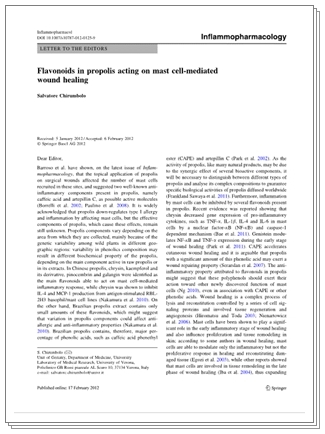
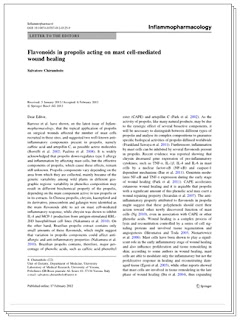
Barroso et al. have shown, on the latest issue of Inflammopharmacology, that the topical application of propolis on surgical wounds affected the number of mast cells recruited in these sites, and suggested two well-known anti-inflammatory components present in propolis, namely caffeic acid and artepillin C, as possible active molecules (Borelli et al. 2002; Paulino et al. 2008). It is widely acknowledged that propolis down-regulates type I allergy and inflammation by affecting mast cells, but the effective components of propolis, which cause these effects, remain still unknown.

Propolis components vary depending on the area from which they are collected, mainly because of the genetic variability among wild plants in different geographic regions; variability in phenolics composition may result in different biochemical property of the propolis, depending on the main component active in raw propolis or in its extracts. In Chinese propolis, chrysin, kaempferol and its derivative, pinocembrin and galangin were identified as main flavonoids able to act on mast cell-mediated inflammatory response, while chrysin was shown to inhibit IL-4 and MCP-1 production from antigen-stimulated RBL-2H3 basophil/mast cell lines (Nakumura et al. 2010). On the other hand, Brazilian propolis extract contains only small amounts of these flavonoids, which might suggest that variation in propolis components could affect anti-allergic and anti-inflammatory properties (Nakumura et al. 2010). Brazilian propolis contains, therefore, major percentage of phenolic acids, such as caffeic acid phenethyl ester (CAPE) and artepillin C (Park et al. 2002). 
excerpt online at SpringerLink.com
As the activity of propolis, like many natural products, may be due to the synergic effect of several bioactive components, it will be necessary to distinguish between different types of propolis and analyse its complex compositions to guarantee specific biological activities of propolis diffused worldwide (Frankland Sawaya et al. 2011). Furthermore, inflammation by mast cells can be inhibited by several flavonoids present in propolis. Recent evidence was reported showing that chrysin decreased gene expression of pro-inflammatory cytokines, such as TNF-ά, IL-1β, IL-4 and IL-6 in mast cells by a nuclear factor-κB (NF- κ B) and caspase-1 dependent mechanism (Bae et al. 2011). Genistein modulates NF- κ  B and TNF-ά expression during the early stage of wound healing (Park et al. 2011). CAPE accelerates cutaneous wound healing and its is arguable that propolis with a significant amount of this phenolic acid may exert a wound repairing property (Serarslan et al. 2007). 

The anti-inflammatory property attributed to flavonoids in propolis might suggest that these polyphenols should exert their action toward other newly discovered function of mast cells (Ng 2010), even in association with CAPE or other phenolic acids. Wound healing is a complex process of lysis and reconstitution controlled by a series of cell signaling proteins and involved tissue regeneration and angiogenesis (Hiromatsu and Toda 2003; Nienartowicz et al. 2006). Mast cells have been shown to play a significant role in the early inflammatory stage of wound healing and also influence proliferation and tissue remodeling in skin…

Propolis May Help Treat Asthmatic Children

CAPE, a predominant compound found in propolis, has been identified to possess other important capacities:
 - antiviral (König and Dustmann, 1985)
 - anti-inflammatory (Bankova et al., 1983) 
 - antimetastatic activity against mammary carcinoma (Bašic et al., 1997)
 - anti-bacterial activity on gram-positive & negative micro-organisms (Villanueva et al., 1970, Cizmarik & Matel, 1970, 1973)


The Immunoregulatory Effects of Caffeic Acid Phenethyl Ester on the Cytokine Secretion of Peripheral Blood Mononuclear Cells From Asthmatic Children
Pediatrics and Neonatology, Volume 52, Issue 6, December 2011, Pages 327-331

Background:
Asthma is a chronic inflammatory disease of the airways for which current treatments are mainly based on pharmacological interventions, such as glucocorticoid therapy. Our objective was to study the immunoregulatory effects of caffeic acid phenethyl ester (CAPE, a phytochemical synthesized from propolis) on cytokine secretion of peripheral blood mononuclear cells (PBMCs) from asthmatic children.

Methods:
PBMCs from asthmatic children (5.5 ± 3.3 years old, n = 28) and healthy children (5.6 ± 2.8 years old, n = 23) were co-cultured with CAPE in vitro with and without phorbol-12-myristate-13-acetate-ionomycin.

Results:
Our results show that predominant interleukin 4 (IL-4) and interferon-gamma secretion of cultured supernatant were detected in healthy donors compared with asthmatics. In the presence of phorbol-12-myristate-13-acetate-ionomycin, with or without CAPE treatment, the asthmatic children showed significantly decreased levels of IL-10 secretion compared with the healthy controls. However, CAPE significantly decreased IL-10 and interferon-gamma in healthy donors. There was a slight but not statistically significant reduction of IL-4 secretion in CAPE-treated PBMCs compared with untreated control PBMCs from the healthy children. Our data also shows that CAPE significantly enhanced transforming growth factor-beta 1 production from PBMCs from asthmatic children.

Conclusion:
The immunoregulatory effects of CAPE on human PBMCs may be through the induction of regulatory T cells, as evidenced by the enhanced transforming growth factor-beta 1 production from PBMCs from asthmatic children in our study.

Propolis Shows Anti-Inflammatory Action in Intestines

As usual, Propolis proves its functionality in a mucuos environment with anti-inflammatory activity. I wonder if CAPE will also exhert its anti-tumor properties at the same time...


Catechols in Caffeic Acid Phenethyl Ester are Essential for Inhibition of TNF-Mediated IP-10 Expression Through NF-κB-Dependent But HO-1- and p38-Independent Mechanisms in Mouse Intestinal Epithelial Cells

Scope: 
Caffeic acid phenethyl ester (CAPE) is an active constituent of honeybee propolis inhibiting nuclear factor (NF)-κB. The aims of our study were to provide new data on the functional relevance and mechanisms underlying the role of CAPE in regulating inflammatory processes at the epithelial interface in the gut and to determine the structure/activity relationship of CAPE.

Methods and results: 
CAPE significantly inhibited TNF-induced IP-10 expression in intestinal epithelial cells. Using various analogues, we demonstrated that substitution of catechol hydroxyl groups and addition of one extra hydroxyl group on ring B reversed the functional activity of CAPE to inhibit IP-10 production. The anti-inflammatory potential of CAPE was confirmed in ileal tissue explants and embryonic fibroblasts derived from TNF(ΔARE/+) mice. Interestingly, CAPE inhibited both TNF- and LPS-induced IP-10 production in a dose-dependent manner, independently of p38 MAPK, HO-1 and Nrf2 signaling pathways.

We found that CAPE did not inhibit TNF-induced IκB phosphorylation/degradation or nuclear translocation of RelA/p65, but targeted downstream signaling events at the level of transcription factor recruitment to the gene promoter.

Conclusion: 
This study reveals the structure-activity effects and anti-inflammatory potential of CAPE in the intestinal epithelium.

Propolis Component Key in Treating Allergic Airway Disease


About this Journal

One of the many compounds of Propolis, CAPE has the super-hero force to aid the human condition...


Caffeic Acid Phenethyl Ester Suppresses Eotaxin Secretion and Nuclear p-STAT6 in Human Lung Fibroblast Cells
J Microbiol Immunol Infect, 2011 May 19

BACKGROUND: 

Caffeic acid phenethyl ester (CAPE), an active component of propolis, has been proven to have anti-inflammatory and antiallergic properties. We have investigated the activity of CAPE in regulating cytokine-induced eotaxin production and its related signal protein, signal transducer and activator of transcription 6 (STAT6), in human lung fibroblast.

METHODS: 

The CCD-11Lu human lung fibroblast cell line was used as an in vitro model. Cells were pretreated with CAPE followed by stimulation with interleukin-4 and tumor necrosis factor alpha. The levels of eotaxin in cultured supernatants were measured by enzyme-linked immunosorbent assay. The amounts of STAT6 and phosphorylated STAT6 in cellular nuclear protein extracts were determined by Western blot analysis. STAT6 DNA binding activities were detected by electrophoretic mobility shift assay.

RESULTS: 

Pretreated CCD-11Lu cells with noncytotoxic doses (0.1-10μM) of CAPE inhibited the production of eotaxin under stimulation of interleukin-4 (10ng/mL) and tumor necrosis factor alpha (10ng/mL). CAPE pretreatment also decreased the amount of phosphorylated STAT6 and the STAT6 DNA binding complexes in nuclear extracts.

CONCLUSION: 

CAPE inhibited the production of eotaxin protein in stimulated human lung fibroblast cells in a dose-dependent manner. This activity is, at least, through STAT6 inhibition. We suggest that CAPE is a promising agent in controlling eotaxin secretion and subsequent eosinophils influx and may therefore have a potential role to play in treating allergic airway disease

Propolis Component Inhibits Breast Cancer Tumor Growth

more promising news for the use of Propolis as an anti-tumor agent...


Caffeic Acid Phenethyl Ester (CAPE), Derived from a Honeybee Product Propolis, Exhibits a Diversity of Anti-Tumor Effects in Pre-Clinical Models of Human Breast Cancer
Cancer Letters, Article in Press

Breast cancer (BC) patients use alternative and natural remedies more than patients with other malignancies. Specifically, 63–83% use at least one type of alternative medicine and 25–63% use herbals and vitamins.

Propolis is a naturopathic honeybee product, and CAPE (caffeic acid phenethyl ester), is a major medicinal component of propolis. CAPE, in a concentration dependent fashion, inhibits MCF-7 (hormone receptor positive, HR+) and MDA-231 (a model of triple negative BC (TNBC) tumor growth, both in vitro and in vivo without much effect on normal mammary cells and strongly influences gene and protein expression.

It induces cell cycle arrest, apoptosis and reduces expression of growth and transcription factors, including NF-κB. Notably, CAPE down-regulates mdr-1 gene, considered responsible for the resistance of cancer cells to chemotherapeutic agents. Further, CAPE dose-dependently suppresses VEGF formation by MDA-231 cells and formation of capillary-like tubes by endothelial cells, implicating inhibitory effects on angiogenesis.

In conclusion, our results strongly suggest that CAPE inhibits MDA-231 and MCF-7 human breast cancer growth via its apoptotic effects, and modulation of NF-κB, the cell cycle, and angiogenesis.

Propolis Bioflavonoid Shows Anti-Cancer Activity

Effect of Propolis and Caffeic Acid Phenethyl Ester (CAPE) on NFκB Activation by HTLV-1 Tax
Antiviral Research, Article in Press


HTLV-1 is the etiological agent of an aggressive malignancy of the CD4+ T-cells, adult T-cell leukemia (ATL) and other sever clinical disorders. The viral Tax protein is a key factor in HTLV-1 pathogenicity. A major part of Tax oncogenic potential is accounted for by its capacity of inducing the transcriptional activity of the NFκB factors, which regulate the expression of numerous cellular genes. 

Propolis (PE), a natural product produced by honeybees, has been used for long time in folk medicine. One of PE active components, caffeic acid phenylethyl ester (CAPE), was well characterized and found to be a potent inhibitor of NFκB activation. Therefore, the aim of this study was to pursue the possibility of blocking Tax oncogenic effects by treatment with these natural products. 

Human T-cell lines were used in this study since these cells are the main targets of HTLV-1 infections. We tried to determine which step of Tax-induced NFκB activation is blocked by these products. 

Our results showed that both tested products substantially inhibited activation of NFκB-dependent promoter by Tax. However, only PE could efficiently inhibit also the Tax-induced activation of SRF- and CREB- dependent promoters. 

Our results showed also that PE and CAPE strongly prevented both Tax binding to IκBα and its induced degradation by Tax. However, both products did not interfere in the nuclear transport of Tax or NFκB proteins.
 
Support : Creating Website | SEO Template | Free Template
Copyright © 2011. Natural Medicine - All Rights Reserved
Proudly powered by Blogger