Showing posts with label anti-inflammatory. Show all posts

Propolis Makes Good Root Canals, Better!

What more could you ask for in a single ingredient? Propolis has antibacterial, antifungal, analgesic and anti-inflammatory properties. Naturally, this study found propolis to be alternative root canal medication. Of course, using a good propolis toothpaste everyday could avoid letting things get to this point...

Histopathological Analysis of Corticosteroid-Antibiotic Preparation and Propolis Paste Formulation as Intracanal Medication after Pulpectomy: An in vivo Study
J Appl Oral Sci, 2012 February

Intracanal medication in pulpectomy therapy is used between appointments with the objective of reducing pain and inflammatory processes in pulp and periapical tissues. Propolis has been known as a natural antibiotic and has been subject of medical and dental research due to its therapeutic properties such as antibiotic, analgesic and anti-inflammatory effects.

OBJECTIVE:
The aim was to carry out an in vivo evaluation of the periapical tissue response to propolis paste when used as an intracanal medication in the teeth of dogs after pulpectomy.

MATERIAL AND METHODS:
72 dog's incisors were selected for the experiment. After biomechanical preparation the root canal was filled with a corticosteroid-antibiotic preparation, experimental propolis paste, non-medicament (negative control) or non-pulpectomy at all (positive control). The medications were left inside the root canal for 7, 14 or 28 days. At the end of the experimental period histological sections were prepared and all laboratories processes for Harris hematoxylin and eosin staining was proceeded followed by the analysis using an optical microscope. Sections were classified according to a score representing the inflammatory events observed: the presence of polymorphonuclear neutrophils, polymorphonuclear eosinophils, lymphocytes and plasma cells, macrophages and/or giant cells, fibrous condensation and abscesses.

RESULTS:
There were statistically significant differences between the tissue reactions caused by the two substances being tested, after different experimental periods, with the periapical tissue that was in contact with propolis paste exhibiting fewer inflammatory reactions in comparison to corticosteroid-antibiotic preparation.

CONCLUSIONS:
The low tissue responses from propolis paste suggest that this material could be considered as an option for root canal medication after pulpectomy... Furthermore, the propolis paste was more effective at controlling the inflammatory response over the 28-day experimental period.

Propolis Protects Against Chemo & Radio Therapy-Induced Toxicity

Propolis protects prophylactically and preventatively ... an amazing feature that also modulates the immune system by boosting or balancing the production of healthy cells...


The Potential Usage of Caffeic Acid Phenethyl Ester (CAPE) Against Chemotherapy-Induced and Radiotherapy-Induced Toxicity
CellBiochem Funct, 2012 March 20

Protection of the patients against the side effects of chemotherapy and radiotherapy regimens has attracted increasing interest of clinicians and practitioners.

Caffeic acid phenethyl ester (CAPE), which is extracted from the propolis of honeybee hives as an active component, specifically inhibits nuclear factor κB at micromolar concentrations and show ability to stop 5-lipoxygenase-catalysed oxygenation of linoleic acid and arachidonic acid. CAPE has antiinflammatory, antiproliferative, antioxidant, cytostatic, antiviral, antibacterial, antifungal and antineoplastic properties.

The purpose of this review is to summarize in vivo and in vitro usage of CAPE to prevent the chemotherapy-induced and radiotherapy-induced damages and side effects in experimental animals and to develop a new approach for the potential usage of CAPE in clinical trial as a protective agent during chemotherapy and radiotherapy regimens.

Propolis Helps Treat Middle Ear Infections

Propolis and its powerful, naturally-ocurring ingredient, CAPE (caffeic acid phenethyl ester) is well-known to aid human and animal species...

Effect of Caffeic Acid Phenethyl Ester (CAPE) on H(2)O(2) Induced Oxidative and Inflammatory Responses in Human Middle Ear Epithelial Cells

OBJECTIVE:
Acute otitis media (OM) is a common pediatric disease. Recent research into the pathogenesis of OM has focused on oxidative damage, induced by oxygen free radicals, to the middle ear mucosa along with inflammation. Caffeic acid phenethyl ester (CAPE) is a biologically active ingredient of propolis honey bees, with antioxidative and anti-inflammatory activities. The effect of CAPE on hydrogen peroxide (H(2)O(2))-induced inflammatory and oxidative reactions in the middle ear is still not known. The aim of this study was to evaluate the anti-inflammatory and antioxidative effects of CAPE on cultured human middle ear epithelial cells (HMEECs).

METHODS:
The inflammatory injury of H(2)O(2) and the anti-inflammatory effect of CAPE were determined by measuring levels of pro-inflammatory cytokines (tumor necrosis factor (TNF)-α and COX-2) with real-time reverse transcription polymerase chain reaction and Western blot analysis. Oxidative stress induced by H(2)O(2) and antioxidative effects of CAPE were evaluated directly by reactive oxygen species (ROS) production using flow cytometric analysis of 5-(and-6)-chloromethyl-2',7'-dichlorodihydrofluorescein diacetate, acetyl ester (CM-H(2)DCFDA), and indirectly by the expression of superoxide dismutase (SOD) using Western blot analysis. The effect of CAPE was compared with N-acetyl cysteine (NAC) which has well-known antioxidative and anti-inflammatory effects.

RESULTS:
CAPE significantly inhibited H(2)O(2)-induced upregulation of TNF-α and COX-2 expression in a dose and time dependent manner. ROS accumulation induced by H(2)O(2) stimulation was decreased by CAPE pretreatment. Induced SOD expression after H(2)O(2) stimulation was diminished by CAPE pretreatment. The anti-inflammatory and antioxidative effects of CAPE were similar to those of NAC.

CONCLUSIONS: 
These findings suggest that inflammation induced by H(2)O(2) can be inhibited by CAPE via inhibition of the expression of pro-inflammatory cytokines such as TNF-α and COX-2. Furthermore, CAPE has antioxidative effects, which decreases the need for endogenous SOD expression.

Propolis Flavonoids Accelerate Wound Healing

Propolis flavonoids are numerous but those of great interest are CAPE (caffeic acid phenethyl ester), chrysin, kaempferol, pinocembrin, galangin and artepillin C. These vary on the geographical source of propolis, due the wide variety of polyphenols harvested by the honeybees in the region. Nonetheless, the anti-inflammatory effects have great importance for many applications...

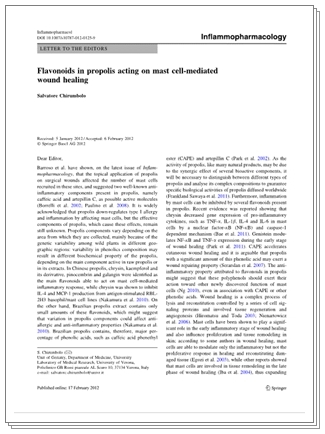
Flavonoids in propolis acting on mast cell-mediated wound healing
Inflammapharmacology, 2012 Feb 17
Salvatore Chirumbolo, University of Verona Italy 


Barroso et al. have shown, on the latest issue of Inflammopharmacology, that the topical application of propolis on surgical wounds affected the number of mast cells recruited in these sites, and suggested two well-known anti-inflammatory components present in propolis, namely caffeic acid and artepillin C, as possible active molecules (Borelli et al. 2002; Paulino et al. 2008). It is widely acknowledged that propolis down-regulates type I allergy and inflammation by affecting mast cells, but the effective components of propolis, which cause these effects, remain still unknown.

Propolis components vary depending on the area from which they are collected, mainly because of the genetic variability among wild plants in different geographic regions; variability in phenolics composition may result in different biochemical property of the propolis, depending on the main component active in raw propolis or in its extracts. In Chinese propolis, chrysin, kaempferol and its derivative, pinocembrin and galangin were identified as main flavonoids able to act on mast cell-mediated inflammatory response, while chrysin was shown to inhibit IL-4 and MCP-1 production from antigen-stimulated RBL-2H3 basophil/mast cell lines (Nakumura et al. 2010). On the other hand, Brazilian propolis extract contains only small amounts of these flavonoids, which might suggest that variation in propolis components could affect anti-allergic and anti-inflammatory properties (Nakumura et al. 2010). Brazilian propolis contains, therefore, major percentage of phenolic acids, such as caffeic acid phenethyl ester (CAPE) and artepillin C (Park et al. 2002). 

excerpt online at SpringerLink.com
As the activity of propolis, like many natural products, may be due to the synergic effect of several bioactive components, it will be necessary to distinguish between different types of propolis and analyse its complex compositions to guarantee specific biological activities of propolis diffused worldwide (Frankland Sawaya et al. 2011). Furthermore, inflammation by mast cells can be inhibited by several flavonoids present in propolis. Recent evidence was reported showing that chrysin decreased gene expression of pro-inflammatory cytokines, such as TNF-ά, IL-1β, IL-4 and IL-6 in mast cells by a nuclear factor-κB (NF- κ B) and caspase-1 dependent mechanism (Bae et al. 2011). Genistein modulates NF- κ  B and TNF-ά expression during the early stage of wound healing (Park et al. 2011). CAPE accelerates cutaneous wound healing and its is arguable that propolis with a significant amount of this phenolic acid may exert a wound repairing property (Serarslan et al. 2007). 

The anti-inflammatory property attributed to flavonoids in propolis might suggest that these polyphenols should exert their action toward other newly discovered function of mast cells (Ng 2010), even in association with CAPE or other phenolic acids. Wound healing is a complex process of lysis and reconstitution controlled by a series of cell signaling proteins and involved tissue regeneration and angiogenesis (Hiromatsu and Toda 2003; Nienartowicz et al. 2006). Mast cells have been shown to play a significant role in the early inflammatory stage of wound healing and also influence proliferation and tissue remodeling in skin…

Honey Heals Better Than Traditional Burn Treatments

The statistics speak for themselves - honey heals better than SSD treatments used on burn patients - 18 days vs 32 days! In fact, the methodology is completely different. Typical burn unit protocols include scrubbing the wounds, a painful and scarring effect, aimed at keeping bacterial counts low. Honey dressing treatments allow wounds to remain moist, minimizing scarring.  While it may appear unattractive, the antibacterial and anti-inflammatory properties of honey keeps wounds germ-free and speeds healing.


Honey Dressing Versus Silver Sulfadiazene Dressing for Wound Healing in Burn Patients: A Retrospective Study

OBJECTIVE:
The aim was to evaluate the effect of honey dressing and silver sulfadiazene (SSD) dressing on wound healing in burn patients.

MATERIALS AND METHODS: 
We retrospectively reviewed the records of 108 patients (14-68 years of age), with first and second degree burns of less than 50% of the total body surface area admitted to our institution, over a period of 5 years (2004-2008). Fifty-one patients were treated with honey dressings and 57 with SSD. Time elapsed since burn, site, percentage, degree and depth of burns, results of culture sensitivity at various time intervals, duration of healing, formation of post-treatment hypertrophic scar, and/or contracture were recorded and analyzed.

RESULTS:
The average duration of healing was 18.16 and 32.68 days for the honey and SSD group, respectively. Wounds of all patients reporting within 1 h of burns became sterile with the honey dressing in less than 7 days while there was none with SSD. All wounds treated with honey became sterile within 21 days while for SSD-treated wounds, this figure was 36.5%. A complete outcome was seen in 81% of all patients in the "honey group" while in only 37% patients in the "SSD group."

CONCLUSION:
Honey dressings make the wounds sterile in less time, enhance healing, and have a better outcome in terms of hypertropic scars and postburn contractures, as compared to SSD dressings.

Is Propolis Safe, Alternative Medicine?

When you look at the extremely low incidence rate of negative reactions, it begs the question, why isn't it more prevelant?  The source of Propolis is important when wanting to take advantage of specific bioflavonoid activity. But generally speaking, the consistent properties of propolis as an immunostimulating, anti-inflammatory, antiseptic agent are inherently safe.


Is Propolis Safe as an Alternative Medicine?

Abstract:
Propolis is a resinous substance produced by honeybees as defense against intruders. It has relevant therapeutic properties that have been used since ancient times. Nowadays, propolis is of increasing importance as a therapeutic, alone or included in many medicines and homeopathic products or in cosmetics. 

Propolis is produced worldwide and honeybees use the flora surrounding their beehives for its production. Therefore its chemical composition may change according to the flora. The phenolic and volatile fractions of propolis have been revised in the present study, as well as some of the biological properties attributed to this natural product. An alert is given about the need to standardize this product, with quality control. This has already been initiated by some authors, mainly in the propolis from the poplar-type. Only this product can constitute a good complementary and alternative medicine under internationally acceptable quality control…

Conclusions: 
Propolis is a heterogeneous product constituted by several groups of compounds. Moreover, the chemical composition depends strongly on the phytogeographic characteristics of the collection site, as honey bees can only use the plant species existing in their habitats. Their chemical variability can give rise to diverse types of biological activities or diverse structures may present similar properties. Therefore, to make a standardization and quality control of this product is very difficult, particularly if we take into account the quantification of the active substances. Popova et al. [67] have proposed to specify multiple standards for different propolis types according to their plant source and corresponding chemical profile. Popova et al. [141] has already made a standardization for the poplar-type propolis from Europe, Asia, and Americas. More recently, Popova et al. [67] have validated a spectrophotometric method for the quantification of prenylated flavanones in the 'Pacific' propolis from Taiwan. In addition, it is necessary to connect a particular chemical propolis type to a specific type of biological activity for formulating recommendations for the practitioners. Only by following this scheme will it be possible for people to choose and make more efficient use of the beneficial properties of propolis, in respect to complementary and alternative medicine. [142]

In spite of propolis being commonly used in cosmetic and medicinal preparations owing to its antiseptic, anti-inflammatory, and anesthesic properties, it is not completely innocuous because 1.2 to 6.6 patients who were patch-tested for dermatitis were sensitive to propolis. The main allergens were 3-methyl-2-butenyl caffeate and phenylethyl caffeate, that is, components present in the poplar-type propolis. [143] Clinical allergy in humans is presented as contact dermatitis or oral mucositis, beekeepers being the most affected. Nevertheless there has been a recent rise in this incidence among biocosmetic users, on account of the increasing popularity of natural products such as propolis. [144] According to these authors, patients with an allergy to propolis may be at risk of cross-sensitization with balsam of Peru, a common allergen found in flavoring agents, perfumed products, certain spices, and products that contain the peel of citrus fruit.

Therefore, propolis is a complex natural product with a great diversity of chemical structures and subsequent biological activities, nevertheless, it is not completely innocuous and care must been taken, mainly when such a product has a great diversity of origins. An absence of quality control may be pernicious to human health.


Propolis, Abundant Source of Beneficial Effects for Human Health

A molecular review on the rich spectrum of beneficial properties found in Propolis... 


Beneficial Effects of Propolis on Human Health and Neurological Diseases
Frontiers in Bioscience (Elite Ed), 2012 Jan 4

Propolis is a natural product, collected by honeybees Apis mellifera, from various plant sources. Propolis is extensively used in foods and beverages because it improves human health. It contains more than 300 natural compounds such as polyphenols, phenolic aldehydes, sequiterpene-quinones, coumarins, amino acids, steroids and inorganic compounds.

Propolis exhibits a broad spectrum of biological and pharmacological properties such as antimicrobial, antioxidant, anti-inflammatory, immunomodulatory, antitumor, anticancer, antiulcer, hepatoprotective, cardioprotective, and neuroprotective actions. The chemical composition and beneficial properties of propolis vary greatly depending on the phytogeographical areas, seasonal collection time, and botanical source. Polyphenols found in fruits and vegetables are beginning to receive increased attention due to their vital role in protecting neural cells from oxidative stress and neuroinflammation associated with normal aging and chronic age-related diseases.

Propolis is one of the most abundant sources of polyphenols (mainly flavonoids and phenolic acids). This overview is an attempt to discuss the molecular mechanism underlying the potential beneficial effects of propolis on human health and neurological diseases...

Propolis May Help Treat Asthmatic Children

CAPE, a predominant compound found in propolis, has been identified to possess other important capacities:
 - antiviral (König and Dustmann, 1985)
 - anti-inflammatory (Bankova et al., 1983) 
 - antimetastatic activity against mammary carcinoma (Bašic et al., 1997)
 - anti-bacterial activity on gram-positive & negative micro-organisms (Villanueva et al., 1970, Cizmarik & Matel, 1970, 1973)


The Immunoregulatory Effects of Caffeic Acid Phenethyl Ester on the Cytokine Secretion of Peripheral Blood Mononuclear Cells From Asthmatic Children
Pediatrics and Neonatology, Volume 52, Issue 6, December 2011, Pages 327-331

Background:
Asthma is a chronic inflammatory disease of the airways for which current treatments are mainly based on pharmacological interventions, such as glucocorticoid therapy. Our objective was to study the immunoregulatory effects of caffeic acid phenethyl ester (CAPE, a phytochemical synthesized from propolis) on cytokine secretion of peripheral blood mononuclear cells (PBMCs) from asthmatic children.

Methods:
PBMCs from asthmatic children (5.5 ± 3.3 years old, n = 28) and healthy children (5.6 ± 2.8 years old, n = 23) were co-cultured with CAPE in vitro with and without phorbol-12-myristate-13-acetate-ionomycin.

Results:
Our results show that predominant interleukin 4 (IL-4) and interferon-gamma secretion of cultured supernatant were detected in healthy donors compared with asthmatics. In the presence of phorbol-12-myristate-13-acetate-ionomycin, with or without CAPE treatment, the asthmatic children showed significantly decreased levels of IL-10 secretion compared with the healthy controls. However, CAPE significantly decreased IL-10 and interferon-gamma in healthy donors. There was a slight but not statistically significant reduction of IL-4 secretion in CAPE-treated PBMCs compared with untreated control PBMCs from the healthy children. Our data also shows that CAPE significantly enhanced transforming growth factor-beta 1 production from PBMCs from asthmatic children.

Conclusion:
The immunoregulatory effects of CAPE on human PBMCs may be through the induction of regulatory T cells, as evidenced by the enhanced transforming growth factor-beta 1 production from PBMCs from asthmatic children in our study.

Bee Venom Antimicrobial Peptide Has Anti-Inflammatory Properties

Honey bee products deserve further funds to uncover these important discoveries which continue to elevate the merits of Apitherapy. For example, the statistically low cancer rate found in beekeepers worldwide, not to mention the reports of Bee Venom Therapy in treating numerous conditions ranging from Alzheimer's Disease to Parkinson's Disease and Rheumatoid Arthritis...

Consequences of Alteration in the Leucine Zipper Sequence of Melittin in its Neutralization of Lipopolysaccharide-Induced Pro-Inflammatory Response in Macrophage Cells and Interaction with Lipopolysaccharide

Bee venom antimicrobial peptide, melittin, besides showing versatile activity against microorganisms neutralizes lipopolysaccharide (LPS)-induced pro-inflammatory responses in macrophage cells.

However, how the amino acid sequence of melittin contributes in its anti-inflammatory properties is mostly unknown. To determine the importance of the leucine zipper sequence of melittin in its neutralization of LPS-induced inflammatory responses in macrophages and interaction with LPS, anti-inflammatory properties of melittin and its three analogues and their interactions with LPS were studied in detail.

Two of these analogues namely, melittin Mut-1 (MM-1) and melittin Mut-2 (MM-2) possess leucine to alanine substitutions in the single and double heptadic leucine residue(s) of melittin respectively while the third analogue is a scrambled peptide (Mel-SCR) which contains the amino acid composition of melittin with minor rearrangement in its leucine zipper sequence.

Though MM-1 partly inhibited the production of pro-inflammatory cytokines in RAW 264.7 and rat primary macrophage cells in the presence of LPS, MM-2 and Mel-SCR were negligibly active. A progressive decrease in interaction of melittin with LPS, aggregation in LPS and dissociation of LPS aggregates with alteration in the leucine zipper sequence of melittin was observed.

Further, with alteration in the leucine zipper sequence of melittin, these analogues failed to exhibit cellular responses that are associated with neutralization of LPS-induced inflammatory responses in macrophage cells by melittin.

The data indicated a probable important role of the leucine zipper sequence of melittin in neutralizing LPS-induced pro-inflammatory responses in macrophage cells as well as in its interaction with LPS…

Though further studies are required in understanding the role of this motif in these molecules, the data probably indicate that one can design anti-LPS or LPS-binding molecule based on this structural element.

Propolis Boosts Wound Healing

The protective power of propolis instantly boosts wound healing capacities, boosts the immune system and delivers antioxidant, anti-viral, antibacterial properties due to its naturally-occurring bioflavonoid compounds. 

Propolis Anti-Inflammatory Action Boosts Wound Healing Effect of Propolis on Mast Cells in Wound Healing

Wound healing is divided into three phases: inflammatory, proliferative and remodeling. Mast cells participate in all these phases.

The aim of the present study was to determine the effects of propolis on the population of mast cells in oral surgical wounds in comparison to the results obtained with dexamethasone. This study was prospective, in vivo, randomized, semiexperimental, quantitative and comparative animal.

A circular surgical wound was made on the dorsum of the tongue of 90 hamsters divided into three experimental groups: topical application of 30% propolis alcoholic extract (Group 1); 0.1% dexamethasone in orabase cream (Group 2); and orabase cream alone (Group 3). Applications were performed every 12 h throughout the experiment. The postoperative times for killing of the animals were 1, 3, 7, 14 and 28 days. 

The Student's t test for independent samples was employed in the statistical analysis.
In the inflammatory phase of healing, propolis caused a greater reduction in the number of mast cells on the edge and in the central region of the surgical wound in comparison to dexamethasone. Moreover, the number of mast cells on day 1 was lower in the central region of the wounds treated with the orabase cream alone in comparison to dexamethasone.

In conclusion, the anti-inflammatory action of propolis mediated by mast cells was more effective than dexamethasone in the inflammatory phase of healing.

Propolis Demonstrates Anti-Parasitic Capacity

Though Sandflies may not be a problem for some, one bite can induce Leishmaniasis, a potentially fatal disease, as stated in Wikipedia. Fortunately, researchers are exploring the anti-parasitic properties of Propolis, yet another of it's amazing qualities. Thanks to Apitherapy, these discoveries are essentiel for emerging nations lacking in medicinal or financial solutions.


The Effect of Propolis on CCL5 and IFN-γ Expression by Peripheral Blood Mononuclear Cells from Leishmaniasis Patients

Objectives 
Mucocutaneous leishmaniasis is associated with a strong Th1 immune response to Leishmania, which modulates chemokines and their receptors expression, affecting their migratory capacity. There are no antileishmanial vaccines available and chemotherapy still relies on the potentially toxic pentavalent antimonials.

Propolis is a bee product with immunomodulatory and antiparasite activities, and researchers have been attracted to its potential for the development of new drugs.

This work investigated the effects of propolis on CCL5 and IFN-γ expression by peripheral blood mononuclear cells (PBMC) in order to evaluate a possible immunomodulatory action of propolis in patients with leishmaniasis compared to healthy control subjects.

Methods 
PBMC were incubated in the absence or presence of propolis and the evaluation of a possible cytotoxicity of propolis was carried out using MTT assay. The expression level of CCL5 and IFN-γ was determined by real-time PCR.

Key Findings 
Our data indicated that propolis modulates the immune response of leishmaniasis patients in vitro, affecting CCL5 and IFN-γ expression by PBMC.

Conclusions
Data suggested that propolis drives an anti-inflammatory response depending on concentration. Although propolis is a potential source of new and selective drugs for the treatment of leishmaniasis, its usefulness in the therapeutics should be further investigated.

Propolis Exhibits Cytotoxic Effect on Cervical Tumor Cells

Propolis always thrives in protecting the mucuous linings of the body from bacteria, viruses, fungi, inflammation and even tumor cell growth...

Chemical composition of the ethanolic propolis extracts and its effect on HeLa cells.


ETHNOPHARMACOLOGICAL RELEVANCE:
Propolis is a resinous hive product collected by honeybees from various plant sources. It is widely used in traditional medicine and is reported to have a broad spectrum of pharmacological effects (antibacterial, antihepatoxic, antioxidative, anti-inflammatory, etc.). Thus the aim of this study was to assess cytotoxic effect of various ethanol propolis extractions on the cervical tumor cell line (HeLa) and compare it with their phenolic acids and flavonoids composition.

MATERIALS AND METHODS:
Twenty samples of raw propolis were collected from 17 localities of Croatia (I-XVII), 2 of Bosnia and Hercegovina (XVIII, XIX) and 1 of Macedonia (XX). Reverse phase HPLC was used to determine the chemical composition of polyphenols. Biological experiments were carried out in vitro on cervix adenocarcinoma cell line (HeLa).

RESULTS:
Phenolic acids (ferulic acid, p-coumaric acid, caffeic acid) and flavonoids (tectochrysin, galangin, pinocembrin, pinocembrin-7-methylether, chrysin, apigenin, kaempferol, quercetin) have been determined using HPLC analysis in 20 ethanolic propolis extracts. All samples contain tectochrysin in ranges of 0.1988 mg/g (XVIII) to 1.2004 mg/g (III), while caffeic acid and quercetin have not been found. Flavonoid that is most abundant is galangin in ranges from 0.3706 mg/g (XVII) to 47.4879 mg/g (IX). The samples of propolis numbers I, VI and X applied in the investigated concentration range manifested significant reduction of cell growth. GI₅₀ value as indicator of cytotoxicity among propolis samples showed that propolis number VII is the most effective (GI₅₀=76 μg/ml) followed by propolis nos. XV, XVIII and I.

CONCLUSION:
Antiproliferative and cytotoxic effect of propolis on the HeLa cells is not correlating with the concentration of particular components but on establishing the possible synergistic antiproliferative activity of individual phenolic acid and flavonoids. Differences in the chemical composition lead to diversity in biological activity of propolis samples.

Propolis Extract May Prevent Prostate Cancer

The anti-inflammatory action of Propolis is incredibly effective. You'll find it improving respiratory ailments, stimulating immune systems and Propolis is incredible. You'll find it improving respiratory ailments, stimulating immune systems and eliminating viruses or fungi. It can be safely applied to any part of the body of mammals, amphibians and reptiles. Best of all, it's truly a complementary addition to any protocol...  

Effect of Turkish Propolis Extracts on Proteome of Prostate Cancer Cell Line

Proteome Science 2011, Published: 2011, 7-December

Background:
Propolis is a natural, resinous hive product that has several pharmacological activities. Its composition varies depending on the vegetation, climate, season and environmental conditions of the area from where it was collected. Surface enhanced laser desorption ionization time of flight mass spectrometry (SELDI-TOF MS) is a proteomic approach which has been used in cancer proteomics studies. Prostate cancer is one of the most commonly diagnosed cancers in men. It has shown that nutritional supplements rich in polyphenolic compounds such as propolis play a significant role in prostate cancer chemoprevention. The aim of this study is to evaluate if protein expression profile in PC-3 prostate cancer cell lines could be differentiated when incubated with dimethyl sulfoxide and water extracts of Turkish propolis.

Results:
The antioxidant potentials of dimethyl sulfoxide and water extracts of propolis were found in correlation with the amount of total phenolic compounds of them. Dimethyl sulfoxide and water extracts of propolis of 20 ug/mL reduced the cell viability to 24.5% and 17.7 %, respectively. Statistically significant discriminatory peaks between control PC-3 cells and dimethyl sulfoxide extract of propolis-treated PC-3 cells were found to be the proteomic features at m/z 5143, 8703, 12661, 20184 and 32794, detected by CM10 ProteinChip, and the peak at m/z 3772, detected by Q10 ProteinChip. Between control PC-3 cells and water extract of propolis-treated PC-3 cells, statistically significant discriminatory peaks were found to be the proteomic features at m/z 15846, 16052 and 24658, detected by CM10 ProteinChip and the peaks at m/z 10348, 10899 and 11603, detected by Q10 ProteinChip.

Conclusions:
It was concluded that dimethyl sulfoxide and water extracts of Turkish propolis may have anti-proliferative activity through differentiating protein expression profile in PC-3 prostate cancer cell lines along with their antioxidant capacity.

Honey: The 'Bee Penicillin' That Could Even Beat MRSA

a well-researched author with concise references to the latest discoveries of the benefits of honey...


Honey: The 'Bee Penicillin' That Could Even Beat MRSA
By Gloria Havenhand, Daily Mail (UK), 11/19/2011

It is often hailed as a natural, healthy sweetener – but in most cases, honey bought from supermarkets today is simply sugar syrup with no nutritional value at all. To reap the true benefits of what was dubbed ‘the food of the gods’ by the Ancient Greeks, you have to look for the raw variety.

Perfectly clear honey has usually undergone a process of ultrafiltration and pasteurisation, which involves heating and passing it through a fine mesh, to ensure it remains runny at any temperature. This strips away many of the unique chemicals and compounds that make it a nutritious and healing health food…

Raw honey is particularly high in polyphenols, an antioxidant that has been linked to a reduced risk of cancer, lowering blood cholesterol and combating heart disease. The darkest varieties of honey include heather and hedgerow honey, which have a polyphenol content of 201mg per gram. In contrast, rapeseed oil honey, known in supermarkets as ‘blossom honey’, trails behind at just 71mg per gram.

The white ring of pollen on the top contains B vitamins, Vitamins C, D and E as well as minerals and 31 other antioxidants, although to get close to your recommended daily amounts of each nutrient you need a pollen supplement…

The University of Waikato in New Zealand found that when raw honey was applied to MRSA infected antibiotic-resistant wounds, they became sterile and healed so quickly that patients could leave hospital weeks earlier. Scarring was minimised because peeling back a dressing glazed in honey – as opposed to a dry bandage – did not disturb the new tissue underneath. If you suffer a minor wound or burn, glaze a bandage with raw honey and cover. Change the glazed bandage every 24 hours and any cuts or signs of infection should disappear within a week (if not, see a doctor).

While manuka honey – a variety produced using only nectar and pollen from the manuka bush in New Zealand – gets the majority of press for being antibacterial, a good-quality raw UK honey will also be powerfully antibacterial and can kill E.coli and MRSA…

Raw honey’s anti-inflammatory properties can help soothe chronic skin conditions. Cleopatra famously bathed in milk and honey because of their skin-softening qualities – honey is a natural emollient as it is humectant (it attracts water). Melting half a jar of raw honey into a warm bath will promote healing in patients suffering with skin conditions such as psoriasis or eczema, too. Mixed with olive oil, raw honey applied to the scalp is also a great tonic for those suffering with a seborrheic dermatitis (a flaky scalp condition).

Propolis Shows Anti-Inflammatory Action in Intestines

As usual, Propolis proves its functionality in a mucuos environment with anti-inflammatory activity. I wonder if CAPE will also exhert its anti-tumor properties at the same time...


Catechols in Caffeic Acid Phenethyl Ester are Essential for Inhibition of TNF-Mediated IP-10 Expression Through NF-κB-Dependent But HO-1- and p38-Independent Mechanisms in Mouse Intestinal Epithelial Cells

Scope: 
Caffeic acid phenethyl ester (CAPE) is an active constituent of honeybee propolis inhibiting nuclear factor (NF)-κB. The aims of our study were to provide new data on the functional relevance and mechanisms underlying the role of CAPE in regulating inflammatory processes at the epithelial interface in the gut and to determine the structure/activity relationship of CAPE.

Methods and results: 
CAPE significantly inhibited TNF-induced IP-10 expression in intestinal epithelial cells. Using various analogues, we demonstrated that substitution of catechol hydroxyl groups and addition of one extra hydroxyl group on ring B reversed the functional activity of CAPE to inhibit IP-10 production. The anti-inflammatory potential of CAPE was confirmed in ileal tissue explants and embryonic fibroblasts derived from TNF(ΔARE/+) mice. Interestingly, CAPE inhibited both TNF- and LPS-induced IP-10 production in a dose-dependent manner, independently of p38 MAPK, HO-1 and Nrf2 signaling pathways.

We found that CAPE did not inhibit TNF-induced IκB phosphorylation/degradation or nuclear translocation of RelA/p65, but targeted downstream signaling events at the level of transcription factor recruitment to the gene promoter.

Conclusion: 
This study reveals the structure-activity effects and anti-inflammatory potential of CAPE in the intestinal epithelium.

Propolis Extracts May Allow Inexpensive Cancer Treatment

a very concise peer-reviewed article, confirming ONCE AGAIN, that propolis has very real potential to save lives. In the meantime, take your propolis regularly!!!

Cytotoxic Constituents of Propolis Inducing Anticancer Effects: A Review
J Pharm Pharmacol, 2011 Nov;63(11):1378-86

Objectives:
Propolis is a honeybee product used extensively in traditional medicine for its antioxidant, anti-inflammatory, immunomodulatory and anticancer effects. Propolis exhibits a broad spectrum of biological activities because it is a complex mixture of natural substances. In this review, the antitumour effects of propolis extracts and its constituents (e.g. flavonoids, terpenes and caffeic acid phenethyl ester) are discussed.

Key findings:
The effect of propolis on experimental carcinogenesis is discussed, as well as its possible mechanisms of action against tumours, involving apoptosis, cell cycle arrest and interference on metabolic pathways. Propolis seems to be efficient against different tumour cells both in vitro and in vivo, which suggests its potential in the development of new anticancer drugs.

Summary:
Propolis extracts may be important economically and would allow a relatively inexpensive cancer treatment. Preclinical investigations are needed to further elucidate the benefits of propolis and its anti-tumour properties.

Royal Jelly Beneficial for Hypertension, Cholesterol, Bone Loss & Male Infertility

Royal Jelly continues its climb upwards as a respected product for treating important human conditions...


Clinical Advisor, 4-Oct 2011
 …Royaljelly contains a complex mixture of proteins, vitamins, minerals andcarbohydrates. The B vitamins are found in the largest quantity, followedclosely by an assortment of 20 different amino acids, calcium, zinc, iron andmanganese.

A detailedbreakdown of the constituents of royal jelly reveals lipids (3%-7%),carbohydrates (10%-12%), proteins (12%-15%), water (60%-70%) and traces ofminerals and vitamins. Of particular medical interest is the presence of gammaglobulin, one of a group of specific proteins studied for theirimmune-modulating potential and pro-estrogenic compounds...

Science

Due to itsrich content of antioxidants, proteins and other nutrients, royal jelly isreportedly good for whatever ails you. It is specifically recommended fortreatment of hypertension, hyperlipidemia and inflammation, and is beingstudied for a possible anti-tumor effect as well as a treatment for maleinfertility.

In a smalltrial, patients were assigned to the royal jelly intervention or placebo. Treatment-groupparticipants were given 6 g daily of royal jelly formulation for four weeks. Atthe end of the trial, the treatment group's total cholesterol level was reduced6%, and LDL was reduced more than 9%.

Egyptianresearchers investigated the effect of royal jelly on conception rates amongcouples with known male asthenozoospermia... At the end of three monitoredcycles, the successful conception rate of the treatment group was 8.1% comparedwith only 2.6% of the IUI couples. The researchers are still studying themechanism of action in this usage beyond the nutrition-dense composition ofroyal jelly. 


The growthand development of bone cells is another area of focus for royal jellyresearch. Scientists monitored tibial bone density in ovariectomized rats forseven weeks until clinical measurements indicated significant loss of bonedensity. At this point, the treatment group was given a royal jelly supplementand the active control group was given a 17 beta-estradiol treatment.

At the endof treatment, the active control group had 100% reversal of tibial bone loss,and the royal jelly group showed 85% bone recovery. Enhanced gastric absorptionof calcium was found in this and other studies and could account for a synergisticeffect on bone maintenance.
..


Red Propolis Extract Kills More Leukemia Cancer Cells

the unrelenting power of propolis, proving once again its anti-carcinogenic properties...

Comparisonof Effects of the Ethanolic Extracts of Brazilian Propolis on Human LeukemicCells As Assessed with the MTT Assay

Propolis isa resinous product collected by honey bees. It was also reported that propolishas a wide variety of biological actions, including antimicrobial activity andantioxidant, anti-inflammatory, and suppressive effects of dioxin toxicity activities.

The aim ofthis study was to compare the in vitro cytotoxic activities of green propolis(G12) and red propolis (G13) in human leukemia cells. These cells wereincubated with different concentrations of propolis and 48 hours after the IC50was calculated for each cell.

The resultsshowed that the red propolis has cytotoxic effect in vitro higher than greenpropolis. Red propolis was showed to be cytostatic in K562 cells and caused thesame amount of apoptosis as its control Gleevec.

Inconclusion, these results showed that red propolis is more cytotoxic than thegreen propolis in a variety of human cell lines of leukemia. Red propolis maycontain drugs capable of inhibiting cancer cell growth. Therefore, furtherisolation of respective chemical ingredients from the red propolis (G13) foridentification of the activities is necessary.

Royal Jelly Protects Kidneys, Liver from Anti-Cancer Treatments

New research from Turkish researchers confirm the protective properties of Royal Jelly against damage caused by anti-cancer therapies. Could this be new ground towards complementary alternative therapies? 

Royal Jelly Modulates Oxidative Stress and Apoptosisin Liver and Kidneys of Rats Treated with Cisplatin

Abstract:
Cisplatin (CDDP) is one of the most active cytotoxicagents in the treatment of cancer and has adverse side effects such asnephrotoxicity and hepatotoxicity. The present study was designed to determinethe effects of royal jelly (RJ) against oxidative stress caused by CDDP injuryof the kidneys and liver, by measuring tissue biochemical and antioxidantparameters and investigating apoptosis immunohistochemically.

Twenty-four Sprague Dawley rats were divided into fourgroups, group C: control group received 0.9% saline; group CDDP: injected i.p.with cisplatin (CDDP, 7 mg kg(-1) body weight i.p., single dose); group RJ:treated for 15 consecutive days by gavage with RJ (300 mg/kg/day); group RJ +CDDP: treated by gavage with RJ 15 days following a single injection of CDDP.Malondialdehyde (MDA) and glutathione (GSH) levels, glutathione S-transferase(GST), glutathione peroxidase (GSH-Px), and superoxide dismutase (SOD)activities were determined in liver and kidney homogenates, and the liver andkidney were also histologically examined.

RJ elicited a significant protective effect towardsliver and kidney by decreasing the level of lipid peroxidation (MDA), elevatingthe level of GSH, and increasing the activities of GST, GSH-Px, and SOD. In theimmunohistochemical examinations were observed significantly enhanced apoptoticcell numbers and degenerative changes by cisplatin, but these histologicalchanges were lower in the liver and kidney tissues of RJ + CDDP group. Besides,treatment with RJ lead to an increase in antiapoptotic activity hepatocytes andtubular epithelium.

In conclusion, RJ may be used in combination withcisplatin in chemotherapy to improve cisplatin-induced oxidative stressparameters and apoptotic activity...

excerpt:
Recently, royal jelly (RJ) has received particularattention because of studies that have reported that it is a highly efficientantioxidant and has free radical scavenging capacity [4, 15]. Royal jelly is asecretion produced by the hypopharyngeal and mandibular glands of workerhoneybees (Apis mellifera). It contains many important compounds withbiological activity such as free amino acids, proteins, sugars, fatty acids,minerals, and vitamins [16]. So far, RJ has been demonstrated to possessseveral physiological activities in experimental animals, includingvasodilative and hypotensive activities [17], the induction of decrease inserum cholesterol levels [18], antimicrobial [19], antiallergic [20],anti-inflammatory [21], immunomodulatory [22, 23], and antioxidant properties[16]. In addition, Kanbur et al. [24] revealed the protective effect of RJagainst paracetamol-induced liver damage in mice.

 
Support : Creating Website | SEO Template | Free Template
Copyright © 2011. Natural Medicine - All Rights Reserved
Proudly powered by Blogger