Showing posts with label propolis. Show all posts

Propolis Makes Good Root Canals, Better!

What more could you ask for in a single ingredient? Propolis has antibacterial, antifungal, analgesic and anti-inflammatory properties. Naturally, this study found propolis to be alternative root canal medication. Of course, using a good propolis toothpaste everyday could avoid letting things get to this point...

Histopathological Analysis of Corticosteroid-Antibiotic Preparation and Propolis Paste Formulation as Intracanal Medication after Pulpectomy: An in vivo Study
J Appl Oral Sci, 2012 February

Intracanal medication in pulpectomy therapy is used between appointments with the objective of reducing pain and inflammatory processes in pulp and periapical tissues. Propolis has been known as a natural antibiotic and has been subject of medical and dental research due to its therapeutic properties such as antibiotic, analgesic and anti-inflammatory effects.

OBJECTIVE:
The aim was to carry out an in vivo evaluation of the periapical tissue response to propolis paste when used as an intracanal medication in the teeth of dogs after pulpectomy.

MATERIAL AND METHODS:
72 dog's incisors were selected for the experiment. After biomechanical preparation the root canal was filled with a corticosteroid-antibiotic preparation, experimental propolis paste, non-medicament (negative control) or non-pulpectomy at all (positive control). The medications were left inside the root canal for 7, 14 or 28 days. At the end of the experimental period histological sections were prepared and all laboratories processes for Harris hematoxylin and eosin staining was proceeded followed by the analysis using an optical microscope. Sections were classified according to a score representing the inflammatory events observed: the presence of polymorphonuclear neutrophils, polymorphonuclear eosinophils, lymphocytes and plasma cells, macrophages and/or giant cells, fibrous condensation and abscesses.

RESULTS:
There were statistically significant differences between the tissue reactions caused by the two substances being tested, after different experimental periods, with the periapical tissue that was in contact with propolis paste exhibiting fewer inflammatory reactions in comparison to corticosteroid-antibiotic preparation.

CONCLUSIONS:
The low tissue responses from propolis paste suggest that this material could be considered as an option for root canal medication after pulpectomy... Furthermore, the propolis paste was more effective at controlling the inflammatory response over the 28-day experimental period.

Propolis Essential Oil Treats Anxiety and Stress

Propolis contains up to 10% essential oils, more in quantity than most aromatic plants. This could explain why each time we smell propolis or air from the beehive, we experience a nice, relaxing sensation... 


TherapeuticEffects of Propolis Essential Oil on Anxiety of Restraint-Stressed Mice
Hum Exp Toxicol,  2012, February 

Propolishas a broad spectrum of biological activities; however, whether its essentialoils have neuroprotective effects is unknown.

In thisstudy, we found that propolis essential oil (PEO) could significantly reverse theanxiety-like behavior of restraint-stressed mice, and has no effect onlocomotor activity. Furthermore, PEO significantly decreased the plasma levelsof cortisol (CORT), adrenocorticotropic hormone (ACTH) and malondialdehyde(MDA), whereas it increased the activity of superoxide dismutase (SOD) inrestraint-stressed mice.

Theseresults strongly suggest that PEO has therapeutic effects on anxiety throughantagonizing the hyperfunction of hypothalamic–pituitary–adrenal (HPA) axis andimproving the ability of antioxidation in brain tissue.


Apitherapy Symposium, Workshop Boston Area, April 28-29

These workshops and symposiums are fantastic, intense sessions on the truly marvelous merits of honeybees, helping humans and animals with better health...

The American Apitherapy Society, Inc. & the York County Beekeepers Association Present “Honey Bees for Health,” An Apitherapy Symposium & Workshop
April 28-29, 2012
York Harbor Inn, York Harbor, ME
For more information:

All are welcome to this event in York Harbor in Southern Maine, just one hour north of Boston, MA. You will be able to learn from three experienced Apitherapists (two physicians and one acupuncturist), and interact with them and other people interested in Apitherapy. 

This ancient form of medicine with products of the beehive (honey, pollen, propolis, bee venom, and royal jelly) is used for health and healing throughout the world. The use of these products to maintain health is currently becoming well recognized in mainstream as well as scientific publications, and their power to heal when illness or accident occurs is also documented.

Conditions such as arthritis, MS, pain, and wounds are known to respond well to Apitherapy. Examples of material covered at this event are:  
 - adverse reactions, 
 - informed consent 
 - legal issues,
 - treatment of scars
 - Veterinary Apitherapy
 - Apitherapy for pain, arthritis, and accidents

The AAS is a nonprofit membership organization established for the purpose of educating about Apitherapy. This event is a prelude to the more comprehensive program of AAS’s course and conference (known as CMACC) to be given this year, October 5 - 7 in Portland, Oregon.

AAS and YCBA look forward to having you with us at the end of April. Enjoy early Spring in Maine at a beautiful historic inn, close to many of southern Maine’s coastal natural resources, as well as to fine shopping.

Propolis Protects Against Chemo & Radio Therapy-Induced Toxicity

Propolis protects prophylactically and preventatively ... an amazing feature that also modulates the immune system by boosting or balancing the production of healthy cells...


The Potential Usage of Caffeic Acid Phenethyl Ester (CAPE) Against Chemotherapy-Induced and Radiotherapy-Induced Toxicity
CellBiochem Funct, 2012 March 20

Protection of the patients against the side effects of chemotherapy and radiotherapy regimens has attracted increasing interest of clinicians and practitioners.

Caffeic acid phenethyl ester (CAPE), which is extracted from the propolis of honeybee hives as an active component, specifically inhibits nuclear factor κB at micromolar concentrations and show ability to stop 5-lipoxygenase-catalysed oxygenation of linoleic acid and arachidonic acid. CAPE has antiinflammatory, antiproliferative, antioxidant, cytostatic, antiviral, antibacterial, antifungal and antineoplastic properties.

The purpose of this review is to summarize in vivo and in vitro usage of CAPE to prevent the chemotherapy-induced and radiotherapy-induced damages and side effects in experimental animals and to develop a new approach for the potential usage of CAPE in clinical trial as a protective agent during chemotherapy and radiotherapy regimens.

Propolis Helps Treat Middle Ear Infections

Propolis and its powerful, naturally-ocurring ingredient, CAPE (caffeic acid phenethyl ester) is well-known to aid human and animal species...

Effect of Caffeic Acid Phenethyl Ester (CAPE) on H(2)O(2) Induced Oxidative and Inflammatory Responses in Human Middle Ear Epithelial Cells

OBJECTIVE:
Acute otitis media (OM) is a common pediatric disease. Recent research into the pathogenesis of OM has focused on oxidative damage, induced by oxygen free radicals, to the middle ear mucosa along with inflammation. Caffeic acid phenethyl ester (CAPE) is a biologically active ingredient of propolis honey bees, with antioxidative and anti-inflammatory activities. The effect of CAPE on hydrogen peroxide (H(2)O(2))-induced inflammatory and oxidative reactions in the middle ear is still not known. The aim of this study was to evaluate the anti-inflammatory and antioxidative effects of CAPE on cultured human middle ear epithelial cells (HMEECs).

METHODS:
The inflammatory injury of H(2)O(2) and the anti-inflammatory effect of CAPE were determined by measuring levels of pro-inflammatory cytokines (tumor necrosis factor (TNF)-α and COX-2) with real-time reverse transcription polymerase chain reaction and Western blot analysis. Oxidative stress induced by H(2)O(2) and antioxidative effects of CAPE were evaluated directly by reactive oxygen species (ROS) production using flow cytometric analysis of 5-(and-6)-chloromethyl-2',7'-dichlorodihydrofluorescein diacetate, acetyl ester (CM-H(2)DCFDA), and indirectly by the expression of superoxide dismutase (SOD) using Western blot analysis. The effect of CAPE was compared with N-acetyl cysteine (NAC) which has well-known antioxidative and anti-inflammatory effects.

RESULTS:
CAPE significantly inhibited H(2)O(2)-induced upregulation of TNF-α and COX-2 expression in a dose and time dependent manner. ROS accumulation induced by H(2)O(2) stimulation was decreased by CAPE pretreatment. Induced SOD expression after H(2)O(2) stimulation was diminished by CAPE pretreatment. The anti-inflammatory and antioxidative effects of CAPE were similar to those of NAC.

CONCLUSIONS: 
These findings suggest that inflammation induced by H(2)O(2) can be inhibited by CAPE via inhibition of the expression of pro-inflammatory cytokines such as TNF-α and COX-2. Furthermore, CAPE has antioxidative effects, which decreases the need for endogenous SOD expression.

Denver Bee Hosts Apitherapy Seminar, March 27

A special meeting with experienced apitherapist, Dr. Frederique Keller, is certified to be an enlightening, inspiring and stimulating event...  

Apitherapy Evening
March 27, 7pm

Location:  Denver Beekeepers Association Meting
Denver Police Station District 1 Community Room

1311 West 46th Avenue
Denver, Colorado 


Dr. Frederique Keller, licensed acupuncturist and medical herbalist in a private practice that also incorporates classical homeopathy and bee venom therapy as well as utilizes honey, pollen, propolis, royal jelly and bee bread where applicable. She also works in a second office specializing in sports and spinal injuries. 

Propolis Antimicrobial Properties Disinfects Eggs

What's true for humans is also true for chickens - the natural antiseptic properties of propolis have been proven beneficial for numerous species...

Effects of Propolis on Eggshell Microbial Activity, Hatchability, and Chick Performance in Japanese Quail (Coturnix coturnix japonica) Eggs
Poultry Science, 2012 April

Propolis is a sticky resin produced by worker honeybees from substances collected from plants, and it has strong antibacterial and antifungal properties.

The purpose of this study was to establish the effects of propolis on egg weight loss, hatchability, chick performance, and to control microbial activity naturally occurring on eggshells.

A total of 750 fresh eggs was randomly divided into 5 groups. Eggs from the first group were sprayed with ethyl alcohol (70%, A), the second group was sprayed with benzalkonium chloride (B), and the third, fourth, and fifth groups were sprayed with propolis at 3 doses: 5, 10, and 15%. Eggs sprayed with propolis had lower egg weight loss than eggs from groups A and B (P < 0.001). Bacterial activity was reduced significantly in all propolis groups. There were no significant differences between treatments for hatchability, embryonic mortality, BW gain, and relative growth.

Results of the present study indicated that propolis could be an alternative hatching egg disinfectant versus a chemical disinfectant, without adverse effects on hatchability and performance of quail chicks.

Propolis Flavonoids Accelerate Wound Healing

Propolis flavonoids are numerous but those of great interest are CAPE (caffeic acid phenethyl ester), chrysin, kaempferol, pinocembrin, galangin and artepillin C. These vary on the geographical source of propolis, due the wide variety of polyphenols harvested by the honeybees in the region. Nonetheless, the anti-inflammatory effects have great importance for many applications...

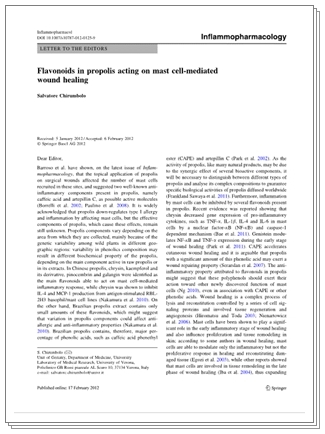
Flavonoids in propolis acting on mast cell-mediated wound healing
Inflammapharmacology, 2012 Feb 17
Salvatore Chirumbolo, University of Verona Italy 


Barroso et al. have shown, on the latest issue of Inflammopharmacology, that the topical application of propolis on surgical wounds affected the number of mast cells recruited in these sites, and suggested two well-known anti-inflammatory components present in propolis, namely caffeic acid and artepillin C, as possible active molecules (Borelli et al. 2002; Paulino et al. 2008). It is widely acknowledged that propolis down-regulates type I allergy and inflammation by affecting mast cells, but the effective components of propolis, which cause these effects, remain still unknown.

Propolis components vary depending on the area from which they are collected, mainly because of the genetic variability among wild plants in different geographic regions; variability in phenolics composition may result in different biochemical property of the propolis, depending on the main component active in raw propolis or in its extracts. In Chinese propolis, chrysin, kaempferol and its derivative, pinocembrin and galangin were identified as main flavonoids able to act on mast cell-mediated inflammatory response, while chrysin was shown to inhibit IL-4 and MCP-1 production from antigen-stimulated RBL-2H3 basophil/mast cell lines (Nakumura et al. 2010). On the other hand, Brazilian propolis extract contains only small amounts of these flavonoids, which might suggest that variation in propolis components could affect anti-allergic and anti-inflammatory properties (Nakumura et al. 2010). Brazilian propolis contains, therefore, major percentage of phenolic acids, such as caffeic acid phenethyl ester (CAPE) and artepillin C (Park et al. 2002). 

excerpt online at SpringerLink.com
As the activity of propolis, like many natural products, may be due to the synergic effect of several bioactive components, it will be necessary to distinguish between different types of propolis and analyse its complex compositions to guarantee specific biological activities of propolis diffused worldwide (Frankland Sawaya et al. 2011). Furthermore, inflammation by mast cells can be inhibited by several flavonoids present in propolis. Recent evidence was reported showing that chrysin decreased gene expression of pro-inflammatory cytokines, such as TNF-ά, IL-1β, IL-4 and IL-6 in mast cells by a nuclear factor-κB (NF- κ B) and caspase-1 dependent mechanism (Bae et al. 2011). Genistein modulates NF- κ  B and TNF-ά expression during the early stage of wound healing (Park et al. 2011). CAPE accelerates cutaneous wound healing and its is arguable that propolis with a significant amount of this phenolic acid may exert a wound repairing property (Serarslan et al. 2007). 

The anti-inflammatory property attributed to flavonoids in propolis might suggest that these polyphenols should exert their action toward other newly discovered function of mast cells (Ng 2010), even in association with CAPE or other phenolic acids. Wound healing is a complex process of lysis and reconstitution controlled by a series of cell signaling proteins and involved tissue regeneration and angiogenesis (Hiromatsu and Toda 2003; Nienartowicz et al. 2006). Mast cells have been shown to play a significant role in the early inflammatory stage of wound healing and also influence proliferation and tissue remodeling in skin…

1st ApiMedical Tourism Conf & ApiExpo, Bangladesh 22-24 June

Apitherapy is recognized complementary and alternative medicine in numerous countries around the world and is continuing to integrate into other countries' health care choices...

First International Api-Medical Tourism Conference, Api-Expo in Bangladesh


Bangladesh Tourism Foundation announced its 'First International Api-Medical Tourism Conference and Api-Expo' 2012 to be held at Dhaka Bangladesh from 22-24 June, 2012.


The Conference and Expo is open to apitherapists, beekeepers, tour operators, scientists and clinicians on beehive products with the objective of opening the world of apitherapy to medical people, beekeepers, alternative health practitioners and tour operators. The goal is that ApiMedical Tourism will rise due to the increasing interest in apiculture and apitherapy.

Speakers will deliver the keynotes in the plenary sessions that will improve and refresh the global knowledge base. The conference platform is targeted to health specialists, researchers and ordinary practitioners with a therapeutic interest towards the uses of honey, apitoxin, royal jelly, bees wax, propolis and bee pollen.

For more information, contact: 
Mokhlesur Rahman
President,
Bangladesh Tourism Foundation and Coordinator
First International Api-Medical Tourism Conference and Api-Expo 2012

Conference Secretariat
Room 305, Academic Building, Faculty of Business Studies, University of Dhaka, Bangladesh
Tel: (+8802)9661920-70 (hunting), Ext- 7970
Mobile: +880155245657, 01714117801
e-mail: gtldhaka@yahoo.com

Propolis, Modulator for Immune & Inflammatory Responses

Propolis is truly a remarkable therapeutic agent, proven here to be an effective cellular regulator, independently and with its complementary co-phyto ingredients...

The Effects of Propolis and Its Isolated Compounds on Cytokine Production by Murine Macrophages
PhytotherapyResearch, 25 January 2012

Since propolis and phenolic compounds, such as cinnamic and coumaric acids, have several biological properties, their immunomodulatory effect on cytokine production (IL-1β, IL-6 and IL-10) was investigated.

Peritoneal macrophages from BALB/c mice were incubated with propolis, coumaric and cinnamic acids in different concentrations and the concentrations that inhibited cytokine production were tested before or after macrophage challenge with LPS, to evaluate a possible immunomodulatory action. Propolis and the acids stimulated IL-1β production, while IL-6 production was significantly inhibited after incubation with propolis (5, 50 and 100 µg/well), coumaric and cinnamic acids (50 and 100 µg/well).

In LPS-challenge protocols, inhibitory concentrations of cinnamic and coumaric acids after LPS incubation prevented efficiently its effects on IL-6 production, whereas propolis inhibited LPS effects both before and after its addition. Propolis, coumaric and cinnamic acids (50 and 100 µg/well) inhibited IL-10 production as well. Both acids showed a similar inhibitory activity on IL-10 production when added after LPS challenge, while propolis counteracted LPS action when added before and after LPS incubation.

Propolis modulated the immune/inflammatory response, depending on the concentration. Its efficiency may occur due to the synergistic effect of its compounds, and cinnamic and coumaric acids may be involved in the action of propolis on cytokine production.

APIS Séminaire d'Apithérapie en Suisse, 24 Mars 2012


Association Suisse d’Apitherapie annonce le Séminaire de Printemps

Samedi 24 mars 2012
à la Salle communale de 1042 Bioley-Orjulaz (Vd)
de 9h00 à 16h45

A P I S
De la mythologie à l’utilisation domestique et thérapeutique des six produits de la ruche 

Animé par M. Christophe Perret-Gentil, botaniste, zoologiste, fondateur et directeur de l’Herboristerie Ariès, thérapeute et enseignant sur les sujets suivants:

- Apis et le Taureau sacré
- Le caractère désintéressé de l’Abeille
- Modèle d’un paysage favorable à l’Abeille & l’Homme
- Les Plantes bio-indicatrices mellifères gage de qualité d’un paysage apicole
- L’hexagone curatif & le cristal de roche
- Apithérapie : les fonctions vitales entre anabolisme et catabolisme

Atelier pratique :
- fabrication d’un baume à base de cire d’abeilles
- critères à prendre en considération pour l’emplacement d’un rucher (terrain) 


Prix du séminaire : 
Membres ASA = Fr 40.-. Couples ASA = Fr 70.-. 
Non membre = Fr 80.-. Repas de midi en plus = Fr 25.-.

Inscription : 
Jusqu’au 3 mars 2012 par mail, courrier ou téléphone auprès d’un membre du comité ou sur le site www.apitherapie.ch

Anti-Tumor Properties Found in Iraqi Propolis

The anti-tumor properties of Propolis continue to be discovered in more diverse geographical locations. Fortunately, its effects are consistently proven very positive and very complementary with other treatments.


Assessing the Anti-tumour Properties of Iraqi Propolis in vitro and in vivo

Abstract:
► We selected one propolis extract with highest cytotoxic effects on different cancer cell lines. 
► We have investigated the chemical composition in quantitative manner by using HPLC-ESI-MS. 
► We have elucidated the cell cycle perturbations induced by propolis compound M. This is the first study that investigated cell cycle perturbations induced by M using BrdU/DNA assay.


The study was designed to evaluate anti-tumour properties of Iraqi propolis collected from Mosul region (M) on HL-60 and HCT-116 cell lines and on HCT-116 in vivo. 
M induced an inhibitory effect against the proliferation of HL-60 and colony potential of HCT-116 cells. The apoptosis in HL-60 cells was associated with down-regulation of Bcl-2 and activation of Bax, while in HCT-116 cells, necrotic features were observed; size of cells was dramatically increased by swelling of cytoplasm and loss of membrane integrity, cell rupture and release of cellular contents. 
Analysis of BrdU/DNA cell cycle in both cell lines showed that M induced cell cycle perturbations in both BrdU positive and BrdU negative cells. The exposure of HL-60 to M caused γ-H2AX in a dose dependent manner and was associated with induction of apoptosis. 
The experiments in HCT-116 tumor-bearing mice showed that oral administration of propolis at doses that caused no detectable toxicity was associated with a decrease in mitotic cells and an increase in endoreduplications, increased p53 and decreased Ki-67 expression of cells in tumor sections. 

This study provides the rationale to investigate the potential beneficial effect of propolis in the diet of patients receiving anti-cancer therapies.


Is Propolis Safe, Alternative Medicine?

When you look at the extremely low incidence rate of negative reactions, it begs the question, why isn't it more prevelant?  The source of Propolis is important when wanting to take advantage of specific bioflavonoid activity. But generally speaking, the consistent properties of propolis as an immunostimulating, anti-inflammatory, antiseptic agent are inherently safe.


Is Propolis Safe as an Alternative Medicine?

Abstract:
Propolis is a resinous substance produced by honeybees as defense against intruders. It has relevant therapeutic properties that have been used since ancient times. Nowadays, propolis is of increasing importance as a therapeutic, alone or included in many medicines and homeopathic products or in cosmetics. 

Propolis is produced worldwide and honeybees use the flora surrounding their beehives for its production. Therefore its chemical composition may change according to the flora. The phenolic and volatile fractions of propolis have been revised in the present study, as well as some of the biological properties attributed to this natural product. An alert is given about the need to standardize this product, with quality control. This has already been initiated by some authors, mainly in the propolis from the poplar-type. Only this product can constitute a good complementary and alternative medicine under internationally acceptable quality control…

Conclusions: 
Propolis is a heterogeneous product constituted by several groups of compounds. Moreover, the chemical composition depends strongly on the phytogeographic characteristics of the collection site, as honey bees can only use the plant species existing in their habitats. Their chemical variability can give rise to diverse types of biological activities or diverse structures may present similar properties. Therefore, to make a standardization and quality control of this product is very difficult, particularly if we take into account the quantification of the active substances. Popova et al. [67] have proposed to specify multiple standards for different propolis types according to their plant source and corresponding chemical profile. Popova et al. [141] has already made a standardization for the poplar-type propolis from Europe, Asia, and Americas. More recently, Popova et al. [67] have validated a spectrophotometric method for the quantification of prenylated flavanones in the 'Pacific' propolis from Taiwan. In addition, it is necessary to connect a particular chemical propolis type to a specific type of biological activity for formulating recommendations for the practitioners. Only by following this scheme will it be possible for people to choose and make more efficient use of the beneficial properties of propolis, in respect to complementary and alternative medicine. [142]

In spite of propolis being commonly used in cosmetic and medicinal preparations owing to its antiseptic, anti-inflammatory, and anesthesic properties, it is not completely innocuous because 1.2 to 6.6 patients who were patch-tested for dermatitis were sensitive to propolis. The main allergens were 3-methyl-2-butenyl caffeate and phenylethyl caffeate, that is, components present in the poplar-type propolis. [143] Clinical allergy in humans is presented as contact dermatitis or oral mucositis, beekeepers being the most affected. Nevertheless there has been a recent rise in this incidence among biocosmetic users, on account of the increasing popularity of natural products such as propolis. [144] According to these authors, patients with an allergy to propolis may be at risk of cross-sensitization with balsam of Peru, a common allergen found in flavoring agents, perfumed products, certain spices, and products that contain the peel of citrus fruit.

Therefore, propolis is a complex natural product with a great diversity of chemical structures and subsequent biological activities, nevertheless, it is not completely innocuous and care must been taken, mainly when such a product has a great diversity of origins. An absence of quality control may be pernicious to human health.


Apithérapie: Médecine d'Avenir, Thérapie de toujours et d'aujourd’hui

Conférence en France sur l'Apitherapie qui va montrer comment on peux vivre mieux avec les produits des abeilles...
French Apitherapy conference showing how we can live better with products from the beehive...


Samedi 21 et dimanche 22 janvier 2012 à Lille             
Premier Colloque International Francophone d’Apithérapie
plus d'infos: afacontact@gmail.com


SAMEDI 21 JANVIER 2012
9h à 9h30 Ouverture du colloque et présentation de la revue d’apithérapie par l’AFA et l’UNAF
Dr Albert BECKER, Docteur en médecine générale, président de l’AFA, président du CETAM (Centre Technique Apicole de Moselle)

9h30 à 10h L’homme et l’abeille
Henri CLÉMENT, apiculteur professionnel, porte parole de l’UNAF

10h à 10h30 La grippe, intérêt de la propolis par son action anti-virale
Nicolas CARDINAULT, Docteur en nutrition, Directeur de Recherches

11h à 11h30 Plaie : Cicatrisation par le miel
Dr Albert BECKER, Docteur en médecine générale, président de l’AFA, président du CETAM

11h30 à 12h Présentation des effets attendus des pro-biotiques de la ruche, entre autre rectocolite hémorragique et maladie de Crohn
Patrice PERCIE DU SERT, ingénieur en agriculture, apiculteur et président d'une entreprise de fabrication de produits de la ruche

14h à 15h30 Les abeilles aux services de la santé de l’Homme, une belle économie pour la santé
Professeur Henri JOYEUX, Professeur de cancérologie et chirurgie digestive à la Faculté de médecine de Montpellier

15h30 à 16h Les différentes méthodes pour l'analyse de la qualité de la propolis (sublimation, HPLC, colorimétrie, etc.)
Alain BEKAERT, Pharmacien et Maître de Conférence à la Faculté de pharmacie de Paris

16h30 à 17h L’action anti-cancéreuse directe et indirecte de la propolis
Nicolas CARDINAULT, Docteur en nutrition, Directeur de Recherches

17h à 17h30 Les différentes méthodes de récolte de la propolis
Patrice PERCIE DU SERT

17h30 à 19h Une table sur « la médecine par les abeilles, l’apithérapie en question »

DIMANCHE 22 JANVIER 2012
9h à 9h30 Quel avenir pour l’apiculture ?
Henri CLEMENT, apiculteur professionnel, porte parole de l’UNAF

9h30 à 10h Prévention et traitement des intolérances/allergies/choc anaphylactique au venin d'abeilles
Dr Stéfan STANGACIU

10h à 10h30 Gelée royale de qualité et thérapie
Professeur Eberhart BENGSCH, Docteur en Sciences, biochimie, virologie, apidologie, Institut Max Planck, Munich (Allemagne) ; Vice-président de l’AFA, expert mondialement reconnu concernant la gelée royale et ses effets antiviraux.

11h à 11h30 Le venin d'abeille médicament : le paradoxe d'un poison qui soigne 
Dr Claude NONOTTE-VARLY, Allergologue, Médecin libérale et attaché des hôpitaux de Hyères et à Ste Anne de Toulon

11h30 à 12h Analyse biologique et chimique des produits de la ruche (application médicale) expérience du CETAM
Dr Albert BECKER

14h à 17h L’apithérapie dans le monde aujourd’hui ouvert au grand public - Accès gratuit
Dr Albert BECKER, Patrice PERCIE DU SERT, Henri CLÉMENT

15 à 17h Ateliers pratiques : Massage au miel, Api-Cosmétique, Digitoponcture, Réflexothérapie avec crèmes à bases de produits d'abeilles, Préparation des produits d'abeilles

14h à 15h30 Les abeilles aux services de la santé de l’Homme, une belle économie pour la santé
Professeur Henri JOYEUX, Professeur de cancérologie et chirurgie digestive à la Faculté de médecine de Montpellier

15h30 à 16h Les différentes méthodes pour l'analyse de la qualité de la propolis (sublimation, HPLC, colorimétrie, etc.)
Alain BEKAERT, Pharmacien et Maître de Conférence à la Faculté de pharmacie de Paris

16h30 à 17h L’action anti-cancéreuse directe et indirecte de la propolis
Nicolas CARDINAULT, Docteur en nutrition, Directeur de Recherches

17h à 17h30 Les différentes méthodes de récolte de la propolis
Patrice PERCIE DU SERT

17h30 à 19h Une table sur « la médecine par les abeilles, l’apithérapie en question »

pdf de prog

Propolis, Abundant Source of Beneficial Effects for Human Health

A molecular review on the rich spectrum of beneficial properties found in Propolis... 


Beneficial Effects of Propolis on Human Health and Neurological Diseases
Frontiers in Bioscience (Elite Ed), 2012 Jan 4

Propolis is a natural product, collected by honeybees Apis mellifera, from various plant sources. Propolis is extensively used in foods and beverages because it improves human health. It contains more than 300 natural compounds such as polyphenols, phenolic aldehydes, sequiterpene-quinones, coumarins, amino acids, steroids and inorganic compounds.

Propolis exhibits a broad spectrum of biological and pharmacological properties such as antimicrobial, antioxidant, anti-inflammatory, immunomodulatory, antitumor, anticancer, antiulcer, hepatoprotective, cardioprotective, and neuroprotective actions. The chemical composition and beneficial properties of propolis vary greatly depending on the phytogeographical areas, seasonal collection time, and botanical source. Polyphenols found in fruits and vegetables are beginning to receive increased attention due to their vital role in protecting neural cells from oxidative stress and neuroinflammation associated with normal aging and chronic age-related diseases.

Propolis is one of the most abundant sources of polyphenols (mainly flavonoids and phenolic acids). This overview is an attempt to discuss the molecular mechanism underlying the potential beneficial effects of propolis on human health and neurological diseases...

Propolis May Help Treat Asthmatic Children

CAPE, a predominant compound found in propolis, has been identified to possess other important capacities:
 - antiviral (König and Dustmann, 1985)
 - anti-inflammatory (Bankova et al., 1983) 
 - antimetastatic activity against mammary carcinoma (Bašic et al., 1997)
 - anti-bacterial activity on gram-positive & negative micro-organisms (Villanueva et al., 1970, Cizmarik & Matel, 1970, 1973)


The Immunoregulatory Effects of Caffeic Acid Phenethyl Ester on the Cytokine Secretion of Peripheral Blood Mononuclear Cells From Asthmatic Children
Pediatrics and Neonatology, Volume 52, Issue 6, December 2011, Pages 327-331

Background:
Asthma is a chronic inflammatory disease of the airways for which current treatments are mainly based on pharmacological interventions, such as glucocorticoid therapy. Our objective was to study the immunoregulatory effects of caffeic acid phenethyl ester (CAPE, a phytochemical synthesized from propolis) on cytokine secretion of peripheral blood mononuclear cells (PBMCs) from asthmatic children.

Methods:
PBMCs from asthmatic children (5.5 ± 3.3 years old, n = 28) and healthy children (5.6 ± 2.8 years old, n = 23) were co-cultured with CAPE in vitro with and without phorbol-12-myristate-13-acetate-ionomycin.

Results:
Our results show that predominant interleukin 4 (IL-4) and interferon-gamma secretion of cultured supernatant were detected in healthy donors compared with asthmatics. In the presence of phorbol-12-myristate-13-acetate-ionomycin, with or without CAPE treatment, the asthmatic children showed significantly decreased levels of IL-10 secretion compared with the healthy controls. However, CAPE significantly decreased IL-10 and interferon-gamma in healthy donors. There was a slight but not statistically significant reduction of IL-4 secretion in CAPE-treated PBMCs compared with untreated control PBMCs from the healthy children. Our data also shows that CAPE significantly enhanced transforming growth factor-beta 1 production from PBMCs from asthmatic children.

Conclusion:
The immunoregulatory effects of CAPE on human PBMCs may be through the induction of regulatory T cells, as evidenced by the enhanced transforming growth factor-beta 1 production from PBMCs from asthmatic children in our study.

Propolis Protects Against Liver Damage

The natural protector, Propolis, proves once again it's an undeniably healthy choice to consume regularly...

Protective Effects of Propolis Extract on Allyl Alcohol-Induced Liver Injury in Mice
Phytomedicine, Volume 4, Issue 4, December 1997, Pages 309-314

Potential protective effects of ethanolic extract of Cuban red propolis against toxicity induced by allyl alcohol in mice was investigated.

Propolis at doses of 25, 50 and 100 mg/i.p. significantly decreased the activity of alanine amino transferase (EC 2.6.1.2) in serum and the levels of mal-ondialdehyde in mouse liver after induction with a dose of 64 mg/kg of allyl alcohol. However, propolis did not increase the concentration of reduced glutathione in mouse liver which is depleted by allyl alcohol. Propolis also reduced liver damage induced by allyl alcohol in mice. This effect was observed by electron microscopy.

The hepatoprotective effects of propolis were dose-dependent and they were produced when propolis was administered 30 min before allyl alcohol administration.

It is indicated that the ethanolic extract of red propolis exerts potential hepatoprotective effects in this experimental model which is probably caused by antioxidative properties (e.g. scavenging action against oxygen radicals) of this extract.

Propolis Boosts Wound Healing

The protective power of propolis instantly boosts wound healing capacities, boosts the immune system and delivers antioxidant, anti-viral, antibacterial properties due to its naturally-occurring bioflavonoid compounds. 

Propolis Anti-Inflammatory Action Boosts Wound Healing Effect of Propolis on Mast Cells in Wound Healing

Wound healing is divided into three phases: inflammatory, proliferative and remodeling. Mast cells participate in all these phases.

The aim of the present study was to determine the effects of propolis on the population of mast cells in oral surgical wounds in comparison to the results obtained with dexamethasone. This study was prospective, in vivo, randomized, semiexperimental, quantitative and comparative animal.

A circular surgical wound was made on the dorsum of the tongue of 90 hamsters divided into three experimental groups: topical application of 30% propolis alcoholic extract (Group 1); 0.1% dexamethasone in orabase cream (Group 2); and orabase cream alone (Group 3). Applications were performed every 12 h throughout the experiment. The postoperative times for killing of the animals were 1, 3, 7, 14 and 28 days. 

The Student's t test for independent samples was employed in the statistical analysis.
In the inflammatory phase of healing, propolis caused a greater reduction in the number of mast cells on the edge and in the central region of the surgical wound in comparison to dexamethasone. Moreover, the number of mast cells on day 1 was lower in the central region of the wounds treated with the orabase cream alone in comparison to dexamethasone.

In conclusion, the anti-inflammatory action of propolis mediated by mast cells was more effective than dexamethasone in the inflammatory phase of healing.

Propolis Demonstrates Anti-Parasitic Capacity

Though Sandflies may not be a problem for some, one bite can induce Leishmaniasis, a potentially fatal disease, as stated in Wikipedia. Fortunately, researchers are exploring the anti-parasitic properties of Propolis, yet another of it's amazing qualities. Thanks to Apitherapy, these discoveries are essentiel for emerging nations lacking in medicinal or financial solutions.


The Effect of Propolis on CCL5 and IFN-γ Expression by Peripheral Blood Mononuclear Cells from Leishmaniasis Patients

Objectives 
Mucocutaneous leishmaniasis is associated with a strong Th1 immune response to Leishmania, which modulates chemokines and their receptors expression, affecting their migratory capacity. There are no antileishmanial vaccines available and chemotherapy still relies on the potentially toxic pentavalent antimonials.

Propolis is a bee product with immunomodulatory and antiparasite activities, and researchers have been attracted to its potential for the development of new drugs.

This work investigated the effects of propolis on CCL5 and IFN-γ expression by peripheral blood mononuclear cells (PBMC) in order to evaluate a possible immunomodulatory action of propolis in patients with leishmaniasis compared to healthy control subjects.

Methods 
PBMC were incubated in the absence or presence of propolis and the evaluation of a possible cytotoxicity of propolis was carried out using MTT assay. The expression level of CCL5 and IFN-γ was determined by real-time PCR.

Key Findings 
Our data indicated that propolis modulates the immune response of leishmaniasis patients in vitro, affecting CCL5 and IFN-γ expression by PBMC.

Conclusions
Data suggested that propolis drives an anti-inflammatory response depending on concentration. Although propolis is a potential source of new and selective drugs for the treatment of leishmaniasis, its usefulness in the therapeutics should be further investigated.
 
Support : Creating Website | SEO Template | Free Template
Copyright © 2011. Natural Medicine - All Rights Reserved
Proudly powered by Blogger